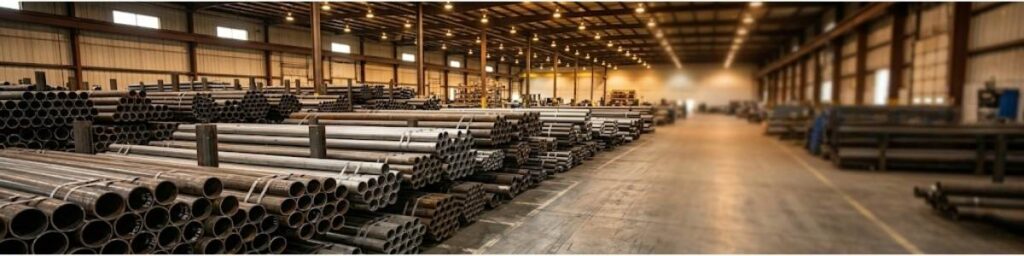
ERW vs. Seamless Steel Pipes: The Complete Buyer’s Guide for Industrial & Construction Projects (2025)
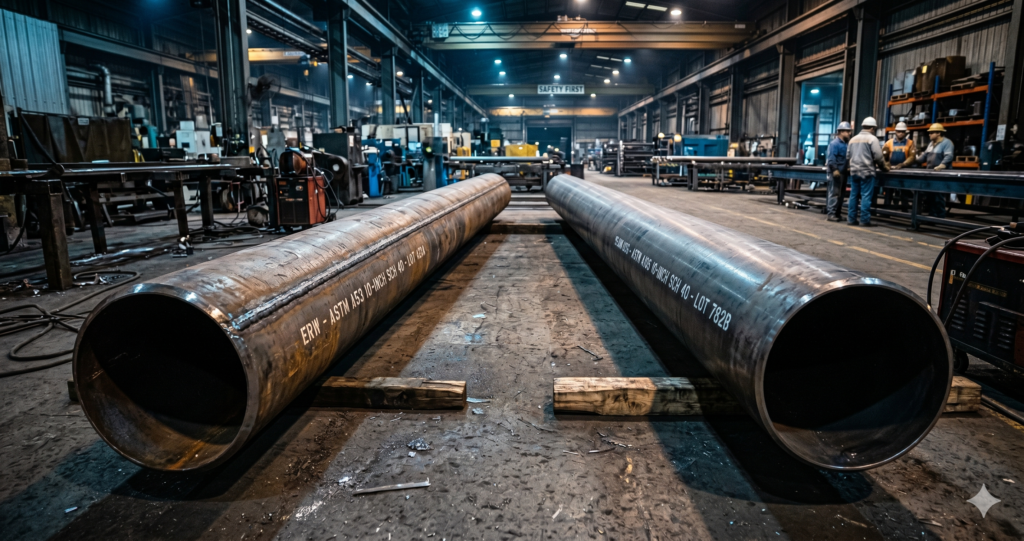
Introduction: The Question Every Procurement Manager Faces
If you are sourcing steel pipes for an infrastructure project, industrial plant, or large-scale construction job, there is one question you will inevitably face at the specification stage:
Should I go with ERW pipes or Seamless pipes?
Both look nearly identical from the outside. Both are made of steel. Yet choosing the wrong type for the wrong application can result in pipeline failures, project cost overruns, safety risks, and non-compliance with quality standards.
At Mittal Traders, we have been supplying iron and steel pipes across industrial, construction, and infrastructure sectors for years. Every week, procurement teams, civil engineers, project managers, and fabricators come to us with this exact question.
This guide gives you the complete, technically sound, and practically useful answer — covering manufacturing differences, mechanical properties, IS and ASTM standards, pressure ratings, cost comparison, and a definitive application checklist, so you can place your next order with full confidence.
What Is an ERW Steel Pipe? (Electric Resistance Welded Pipe)
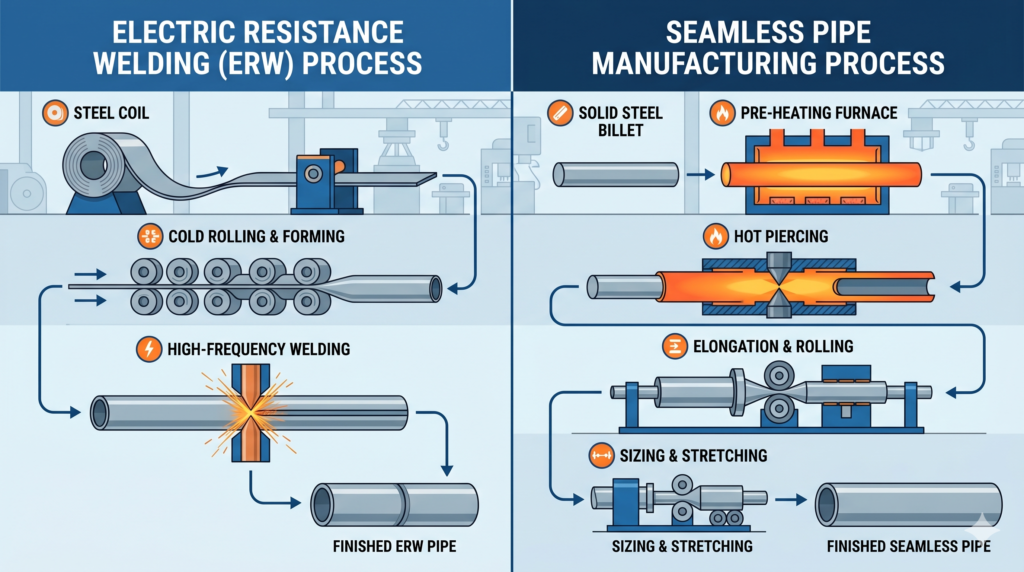
An ERW pipe is manufactured by taking a flat hot-rolled steel coil (also called skelp or strip) and cold-forming it into a cylindrical tube shape through a series of rollers. The two longitudinal edges of the strip are then joined using high-frequency electric resistance welding — no filler metal is used. Instead, heat is generated by the electrical resistance at the edges, fusing them together under pressure. The finished pipe has a single longitudinal weld seam running along its entire length.
Post-weld treatment: Modern ERW pipes undergo weld seam annealing and heat treatment at temperatures above 540°C (as required by ASTM A53), which normalises the weld zone so its mechanical strength closely matches the parent steel. This is a crucial quality step that separates high-grade ERW pipes from substandard ones.
Key ERW Pipe Standards in India and Globally:
- IS 1239 – MS (Mild Steel) ERW pipes for water, gas, and steam
- IS 3589 – Steel pipes for water and sewage (ERW process)
- IS 9295 – Steel tubes for idler rollers for belt conveyors
- ASTM A53 Type E – Black and hot-dipped galvanized steel pipe
- ASTM A500 – Structural tubing (cold-formed welded)
- API 5L PSL1 – Line pipe for oil and gas transmission (ERW grade)
ERW Pipe Size Range:
Standard lengths: 6 metres and 12 metres
Outer diameter: ½ inch to 24 inches (12mm to 610mm)
Wall thickness: 1.0mm to 25mm
What Is a Seamless Steel Pipe?
A seamless pipe has no weld joint anywhere along its body — not on the outside, not on the inside, not at any cross-section. It is manufactured from a solid round steel billet, which is first heated to approximately 800°C–1200°C and then mechanically pierced through the centre using a mandrel or piercing plug. The hollow billet is then rolled and elongated to the desired dimensions.Because the pipe is formed entirely by hot deformation of a single piece of steel, the grain structure remains continuous and uniform throughout the wall, with no heat-affected zone or weld residual stress.
Key Seamless Pipe Standards in India and Globally:
- IS 1161 – Steel tubes for structural purposes (seamless and ERW)
- IS 3601 – Seamless steel tubes for water well casings
- ASTM A106 Grade B – Seamless carbon steel pipe for high-temperature service
- ASTM A53 Type S – Seamless black and galvanized pipe
- API 5L PSL2 – High-grade line pipe for critical oil and gas systems
- ASTM A335 – Alloy steel pipe for high-temperature service
Seamless Pipe Size Range:
Common pressure schedules: Schedule 40, 80, 160, and XXS (Double Extra Strong)
Outer diameter: ⅛ inch to 26 inches (up to 660mm)
Wall thickness: Up to 100mm for thick-walled applications
ERW vs. Seamless Steel Pipes: Head-to-Head Comparison
ERW vs. Seamless Pipe: Side-by-Side Comparison
| Parameter | ERW Steel Pipe | Seamless Steel Pipe |
|---|---|---|
| Manufacturing Process | Cold-formed from steel coil + high-frequency welding | Hot-pierced from solid steel billet |
| Weld Seam | Yes – longitudinal weld seam present | No seam – continuous metal structure |
| Wall Thickness Tolerance | Very precise: ≤ ±0.05mm | Wider variation: ±5% to ±10% |
| Outer Diameter Accuracy | Excellent – cold-formed, tight control | Moderate – hot-rolling causes slight variation |
| Surface Finish | Smooth, uniform inner and outer wall | May have spiral lines or surface scale |
| Pressure Rating | Medium pressure: up to ~7 MPa | High pressure: handles 42+ MPa |
| Temperature Resistance | Suitable up to ~350°C | Suitable for extreme high-temperature service |
| Structural Integrity | Strong; weld zone treated to near-parent strength | Superior; no weld weak points |
| IS Standards | IS 1239, IS 3589, API 5L PSL1 | IS 1161, ASTM A106, API 5L PSL2 |
| Cost (same spec) | 25%–35% lower | 20%–40% higher |
| Lead Time | Shorter – continuous mass production | Longer – complex billet piercing process |
| Size Availability | ½” to 24″ OD | ⅛” to 26″ OD |
| Best Suited For | Construction, water supply, gas distribution, structural | Oil & gas, boilers, refineries, hydraulics |
Critical Differences Between ERW and Seamless Pipes — Explained in Depth
1. Manufacturing Process
The most fundamental difference lies in how these pipes are made.
ERW pipes start as a flat steel coil. The strip is cold-rolled into a tube shape and the edges are welded using high-frequency electrical current. This is a highly automated, efficient process — thousands of small-diameter tubes can be produced per day, which keeps costs low.
Seamless pipes, on the other hand, start as a solid billet of steel. The billet is heated to extreme temperatures and pierced through the center using a mandrel. This is a far more complex and energy-intensive process, which is reflected in the higher price.
2. Strength & Pressure Resistance
This is often the deciding factor in pipe selection.
Seamless pipes — having no weld joint — distribute pressure uniformly across the entire pipe wall. They are the preferred choice for high-pressure, high-temperature environments such as oil and gas pipelines, boiler tubes, and hydraulic systems. Their pressure-bearing capacity can be 15–25 times that of standard ERW pipes.
Modern ERW pipes, however, have come a long way. With advanced weld heat treatment and quality control processes, the weld zone can now match the mechanical strength of the base material in most standard-pressure applications. For medium and low-pressure fluid transportation (up to ~7 MPa), ERW pipes perform excellently.
3. Dimensional Accuracy & Surface Finish
Interestingly, ERW pipes actually win here. Because they are cold-formed from precisely rolled steel strip:
- Outer diameter tolerance can be controlled within ±0.05mm
- Wall thickness uniformity is excellent throughout the pipe length
- Surface finish is smooth, making them ideal for applications where aesthetics or close fit matters
Seamless pipes, formed by the hot-piercing process, are more prone to wall thickness variation (±5–10%) and may have surface irregularities like spiral rolling lines or inclusions that require polishing.
4. Cost Comparison: ERW Pipe Price vs. Seamless Pipe Price in India
For the same grade, outer diameter, and wall thickness specification, seamless steel pipes typically cost 20%–40% more than ERW pipes in the Indian market.
The key cost drivers for seamless pipes are:
- Higher raw material cost (steel billets vs. hot-rolled coil)
- More complex and energy-intensive piercing and rolling process
- Longer production cycle and lower throughput per shift
- Higher rejection rates due to billet defects
For large-volume infrastructure procurement — municipal water pipelines, gas distribution networks, building structural work — the cost premium of seamless pipes simply cannot be justified if ERW pipes meet the design pressure and applicable IS standard.
A useful rule of thumb: Start with “Can ERW meet the pressure and temperature requirement?” If yes, use ERW. If no, budget for seamless.
Industry-Wise Application Guide
Construction and Infrastructure
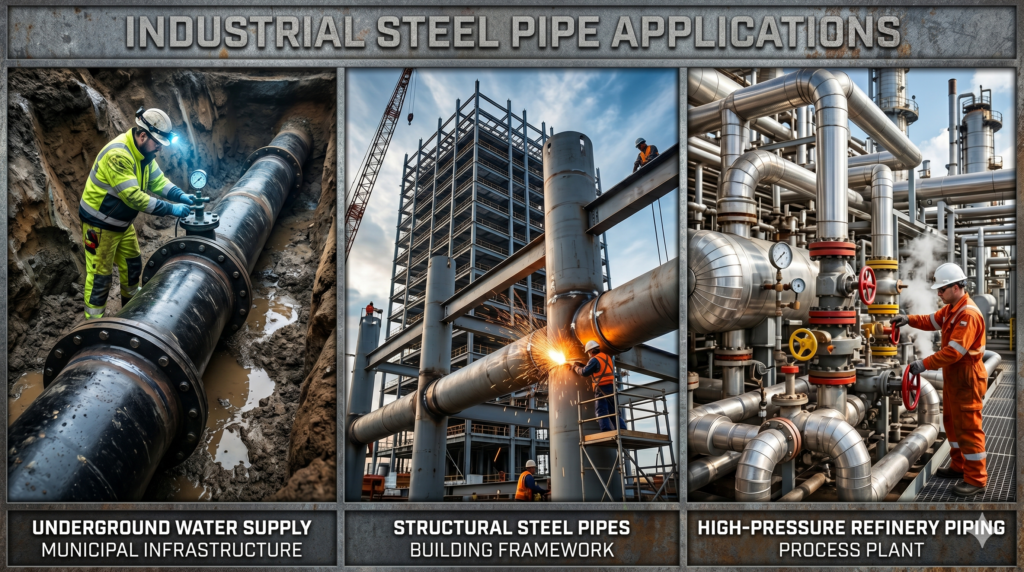
Use ERW pipes (IS 1239 / IS 3589)
- Water supply and distribution networks
- Sewage and drainage pipelines
- Gas distribution networks (medium pressure)
- Scaffolding systems and formwork support
- Structural columns, hollow sections, and frames
- Agricultural irrigation pipelines
ERW pipes are the backbone of India’s construction and urban infrastructure sector. Their cost efficiency, consistent dimensions, and availability under IS standards make them the standard specification for civil and structural work.
Oil and Gas Industry
Use Seamless pipes (API 5L PSL2 / ASTM A106 / ASTM A335)
- Upstream: Oil well casing, tubing, and drill pipes
- Midstream: High-pressure transmission pipelines
- Downstream: Refinery process lines, heat exchangers, reactor vessels
API standards for oil and gas pipelines are strict. In many critical-pressure applications, seamless pipe is the only pipe type that meets the weld joint factor requirement of 1.0.
Boilers, Power Plants, and Pressure Vessels
Use Seamless pipes (ASTM A106 Grade B or C / IS 2062 / ASTM A335)
- Steam boiler tubes
- Superheater and reheater tubes
- Power station pipeline headers
- High-pressure steam distribution
The extreme temperatures (up to 500°C+) and continuous pressure cycling in power plant environments make seamless pipe the only acceptable pipe type. The absence of a weld seam eliminates the primary point of failure under thermal fatigue.
Mechanical Engineering and Automotive
Use ERW or Seamless depending on function:
- Precision shafts, bearing housings → ERW (dimensional accuracy advantage)
- Hydraulic cylinders, high-pressure actuators → Seamless (pressure rating)
- Exhaust systems, chassis tubing → ERW (smooth surface, cost efficiency)
- Engine components under cyclic stress → Seamless (fatigue life)
Municipal and Water Treatment Projects
Use ERW pipes (IS 3589 / IS 1239)
- Treated water transmission mains
- Raw water intake pipelines
- Fire-fighting ring mains
- Cooling water circuits
For municipal water projects funded under government schemes (Smart Cities, AMRUT, Jal Jeevan Mission), pipes are typically specified under IS 3589 — an ERW-compatible standard — due to their cost advantage at scale.
Common Mistakes in ERW vs. Seamless Pipe Procurement
1. Specifying seamless where ERW is sufficient This is the most expensive mistake. Upgrading to seamless for medium-pressure water or gas lines adds 25–40% to material cost with no performance benefit. Always verify the design pressure against the ERW pressure rating before upgrading the specification.
2. Buying ERW for high-pressure or high-temperature service The opposite error. In boiler, refinery, or oil well applications, substituting ERW for seamless may appear to save money but creates safety and compliance risks. Under ASME B31.8, using an ERW pipe in a system designed for a weld joint factor of 1.0 is a code violation.
3. Not verifying the IS standard “MS pipe” is a material type description, not a manufacturing specification. Always confirm whether the project specification calls for IS 1239, IS 3589, IS 1161, or another standard — and procure accordingly.
4. Ignoring the MTC (Mill Test Certificate) Never accept a bulk pipe delivery without a valid MTC from a recognised mill. The MTC confirms chemical composition, mechanical properties, test pressure, and compliance with the specified IS/ASTM/API standard.
5. Overlooking heat treatment on ERW weld seam Not all ERW pipes undergo proper weld seam annealing. Low-grade pipes may skip this step. Always specify “full-body normalised” or “weld seam heat-treated” ERW pipes for any pressure-containing application.
Frequently Asked Questions (FAQ)
Q1: Is ERW pipe as strong as seamless pipe? For medium-pressure, standard-temperature applications, modern high-frequency ERW pipes with weld heat treatment perform comparably to seamless pipes. However, seamless pipes have a higher intrinsic pressure rating (weld joint factor 1.0 vs. 0.8 for ERW under ASME codes) and better fatigue life in cyclic stress environments.
Q2: Which pipe is better for construction — ERW or seamless? For construction and structural applications, ERW pipes under IS 1239 or IS 3589 are the standard and recommended choice. They offer superior dimensional accuracy, consistent supply, and significant cost savings over seamless pipes for applications that do not require high pressure or temperature resistance.
Q3: What is the price difference between ERW and seamless pipes in India? Seamless pipes typically cost 20%–40% more than ERW pipes of the same size and grade in the Indian market. The exact premium depends on the diameter, wall thickness, steel grade, surface treatment (plain, galvanized, coated), and prevailing raw material prices.
Q4: Can ERW pipes be used for gas lines? Yes. ERW pipes under IS 1239 (Part 1) and API 5L PSL1 are widely used for medium-pressure natural gas distribution lines. For high-pressure gas transmission trunks, seamless pipes under API 5L PSL2 are specified.
Q5: What does IS 1239 cover? IS 1239 covers mild steel (MS) tubes (pipes) for water, gas, and steam service, manufactured by the ERW or other welded processes. It specifies three classes — Light, Medium, and Heavy — based on wall thickness.
Q6: How do I choose between Schedule 40 and Schedule 80 pipe? The schedule number indicates wall thickness relative to outer diameter. Schedule 40 is standard for most moderate-pressure applications. Schedule 80 has a thicker wall and is used where higher pressure ratings or greater mechanical strength is required. Both schedules are available in ERW and seamless versions.
Q7: What is API 5L and when is it required? API 5L is the American Petroleum Institute standard for line pipes used in oil and gas transmission systems. PSL1 (Product Specification Level 1) covers standard requirements; PSL2 adds stricter chemical, mechanical, and fracture toughness requirements. Seamless pipes are required for many PSL2 applications.
Summary: ERW or Seamless — Quick Decision Guide
| Your Project Type | Recommended Pipe Type | Applicable Standard |
|---|---|---|
| Municipal water supply pipelines | ERW | IS 3589 / IS 1239 |
| Building structural columns and frames | ERW | IS 1161 / IS 1239 |
| Natural gas distribution (medium pressure) | ERW | IS 1239 / API 5L PSL1 |
| Irrigation and agricultural piping | ERW | IS 1239 |
| Oil & gas high-pressure transmission | Seamless | API 5L PSL2 |
| Boiler tubes and steam systems | Seamless | ASTM A106 / IS 3601 |
| Refinery process lines | Seamless | ASTM A335 / API 5L |
| Hydraulic cylinders and actuators | Seamless | ASTM A519 |
| Automotive structural and exhaust | ERW | ASTM A500 / IS 1239 |
| Power plant pipeline headers | Seamless | ASTM A106 Grade C |
Why Choose Mittal Traders for Your Steel Pipe Requirements?
At Mittal Traders, we supply a comprehensive range of ERW and seamless iron and steel pipes for industrial, construction, and infrastructure projects across India. Our focus is on:
- Verified quality supply from reputed mills with valid MTCs
- Correct standard matching — we help you identify the right IS/ASTM/API specification for your application
- Competitive pricing on both ERW and seamless grades
- Bulk procurement support for large infrastructure and industrial projects
- Expert guidance from our experienced technical team
Whether you are sourcing a few tonnes for a local construction job or hundreds of tonnes for a major industrial project, we can help you get the specification right — and the price right.
📞 Call us today for a consultation and quotation. 🌐 Visit: www.mittaltraders.net